Modern fertility medicine has done extraordinary things — but it has also taught a generation of couples to think of conception as a moment, an event that either happens or does not, often arriving at the end of months of injections and ultrasounds. Ayurveda's view is older and quieter. Conception, it says, is the conclusion of preparation. The body that becomes pregnant did not happen overnight; it was being built for the previous three to six months.
That preparation is called Garbhadhana Sanskar — literally, the ritual of "establishing the womb." It is the first of the sixteen Sanskaras described in classical Ayurveda, and it is the most ignored one in modern times.
The Four Pillars of Healthy Conception
Beej — Pure Seed
The shukra dhatu (in men) and artava (in women) — sperm and ovum quality. This is governed by the seventh and final tissue layer of the body, which is the most refined and the most easily disturbed by stress, alcohol, smoking, and Ama. Cleansing both partners before conception is non-negotiable in classical Ayurveda.
Kshetra — Healthy Soil
The uterine environment. A womb burdened by Ama, fibroids, endometriosis, or chronic inflammation cannot hold a healthy pregnancy easily. Uttara Basti (medicated uterine cleansing) and herbal Rasayanas restore this soil before any seed is planted.
Ritu — Right Season
Both the season of the year and the woman's monthly fertile window. Classical texts describe a 12-day ritukala after menstruation when conception is most favourable. Modern embryology agrees, almost exactly, with this ancient observation.
Manas — Calm Mind
The mental state of both partners at conception is, in Ayurveda's view, transmitted to the child. This is why classical texts prescribe weeks of meditation, prayer, satsang, and mutual care leading up to the attempted conception. Modern epigenetics is now confirming what the rishis intuited.
The Aksharam Pre-Conception Protocol
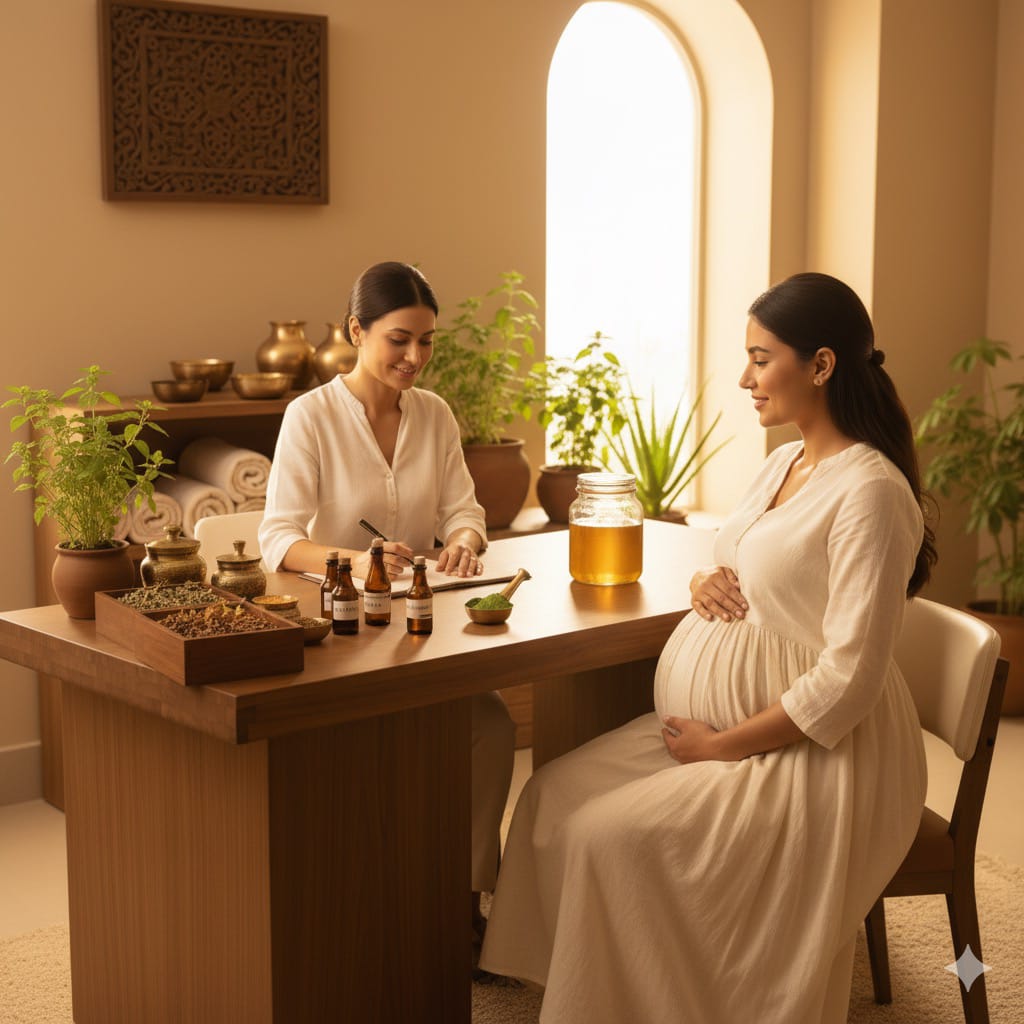
For couples planning a child, our standard recommendation is 3 months of preparation before the attempted conception window. The protocol typically includes:
- Both partners: a tailored Panchakarma — usually mild Virechana for Pitta-type couples, Vamana for Kapha-type, Basti for Vata-type
- Both partners: Beej Shuddhi — herbal protocols to purify reproductive tissues, including Shatavari, Ashwagandha, Kapikacchu, and Suvarna Bhasma in selected cases
- Woman: Uttara Basti for uterine preparation, plus daily yoni pichu
- Both partners: Garbhadhana-specific yoga and pranayama; abstinence from alcohol, tobacco, and over-stimulating screens
- Both partners: Sattvic diet — no leftovers, no canned food, no excessive Pitta-aggravating spices
- Closing ritual: classical Garbhadhana Sanskar, performed at the conjunction of the woman's fertile window and an auspicious tithi, in a calm and prepared environment
What If You Are Already Trying — or in IVF?
Many couples reach us after a year or two of trying, sometimes mid-IVF cycle. The protocol still applies — even three months of preparation before an embryo transfer significantly improves outcomes. We have seen repeated IVF failures convert into success after the underlying terrain was finally cleansed and rebuilt.
For couples with diagnosed infertility — low sperm count, blocked tubes, recurrent miscarriage, unexplained infertility — Garbhadhana Sanskar is layered on top of our Infertility/IVF Success Program, which combines targeted Panchakarma with case-specific medicines.
The Quiet Truth Behind the Sanskar
Beyond protocols and herbs, what Garbhadhana Sanskar really teaches couples is this: a child begins with the parents' health, not with the moment of intercourse. The three months of preparation are themselves the work. By the time conception happens, the body is already a worthy home, and the mind is already a worthy welcome.
Plan Your Conception Consciously
Whether you are planning naturally, recovering from a miscarriage, or in the middle of an IVF cycle, speak with Vaidya Dolly to design your Garbhadhana Sanskar protocol.