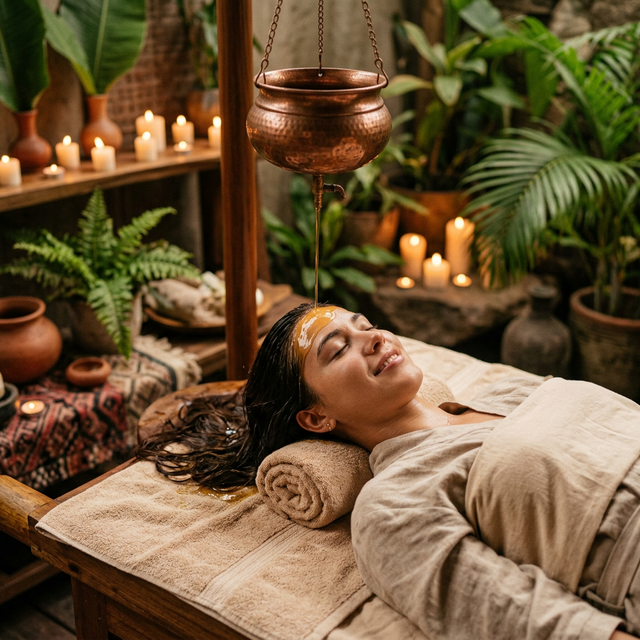
The Sanskrit name itself describes it perfectly. Shiro means head. Dhara means a continuous stream. A vessel suspended above the patient delivers warm medicated oil at a precise temperature, in a steady unbroken thread, onto a single point — the centre of the forehead, just above and between the eyebrows. The point that yoga calls Ajna, that anatomy calls the seat of the pituitary, and that everyone — without being told — recognises as the place where worry lives.
What Actually Happens During Shirodhara
The warm oil striking the forehead does several things at once. It triggers a profound parasympathetic response — heart rate drops, breath slows, stress hormones fall. The continuous tactile sensation occupies the brain's vigilance circuits, the same circuits that keep racing at 3 a.m. Within minutes, brainwaves shift from the tense beta state to relaxed alpha and even theta — the brainwaves of deep meditation.
Modern fMRI studies on Shirodhara have shown reduced activity in the amygdala (the fear centre) and increased activity in the prefrontal cortex (the regulator). Patients describe it as "the first time in years my mind was quiet." Many fall into a sleep deeper than ordinary sleep — what classical texts called Yoga-Nidra.
The Conditions It Helps Most
- Chronic insomnia — particularly when sleep is interrupted by overthinking
- Generalised anxiety disorder — Shirodhara is often more effective than benzodiazepines without the dependency
- Migraine and tension headaches — especially those triggered by stress or screen overuse
- Hypertension — reduces stress-mediated blood pressure spikes
- Hair fall & premature greying — by improving scalp circulation and Vata regulation
- Post-trauma anxiety, burnout, and grief
- Hormonal imbalances rooted in chronic stress (PCOS, irregular cycles, thyroid issues)
Choosing the Right Oil
Shirodhara is not one therapy — it is a family of therapies, defined by the liquid used. The oil or decoction is chosen based on the patient's dosha, condition, and season:
The Common Variants
- Taila Dhara — medicated oil (most common). Indicated for Vata-Pitta imbalance, insomnia, anxiety, and hair fall.
- Ksheera Dhara — medicated milk. Indicated for chronic burnout, mental exhaustion, and skin disorders involving the head.
- Takra Dhara — medicated buttermilk. Specific for psoriasis of the scalp, chronic migraines, and Pitta-pradhan insomnia.
- Kashaya Dhara — herbal decoction. For Pitta dominant conditions, scalp inflammation, and certain neurological disorders.
How a Session Unfolds
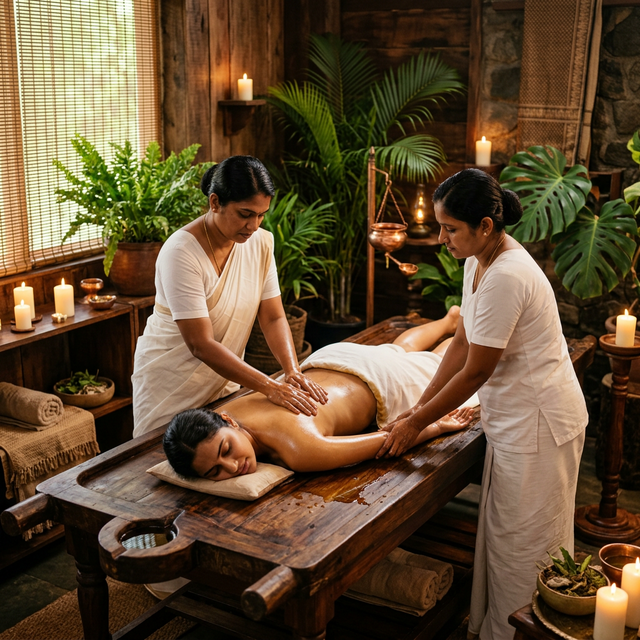
You arrive in loose clothing. We begin with a gentle Shiro-Abhyanga — a five-minute scalp massage to prepare the marma points. You then lie on a wooden therapy table (Droni), and the therapist adjusts the height of the suspended vessel so the oil falls from exactly the right distance — too high stings, too low loses effect.
For the next 30 to 45 minutes, the only sensation is the warm thread of oil moving rhythmically across the forehead. Most patients fall asleep. Some experience old emotions surfacing — Shirodhara has a way of releasing what the body has been holding. Both are normal and welcome.
How Many Sessions?
For acute stress or one-off insomnia, a single session can produce a visible shift. For chronic anxiety, insomnia, or migraine, we typically recommend a course of 7 to 14 daily sessions. For conditions rooted in deep imbalance, Shirodhara is included as part of a longer Panchakarma protocol.
What patients consistently say after a full course is something like: "I didn't realise how loud my mind had become until it went quiet."
Book a Shirodhara Session
If your mind has not stopped in months, this may be the most useful 45 minutes of your year. Speak with Vaidya Dolly to design a Shirodhara protocol for your situation.